
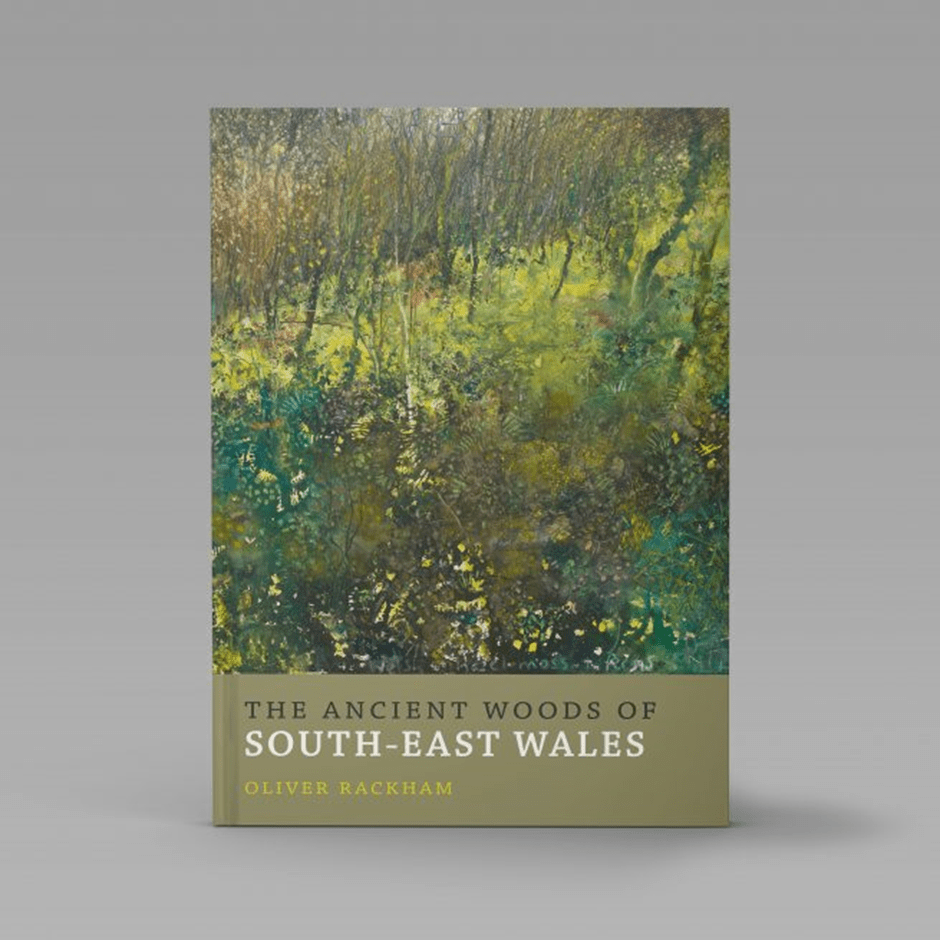
South-east Wales was one of the areas, such as the Forest of Dean, the Southern Lake District, west Argyll, or Killarney, where large areas of woodland survived because there was an industrial use for it (charcoal); in contrast to Norfolk or Montgomery where there were no industrialists to restrain landowners from grubbing up trees. (‘Tudor and Stuart’ chapter in The Ancient Woods of South-East Wales)
A slightly different version of the following review is also due to be published in the online journal ECOS.
I was prompted to read this book following a bus journey from North Powys, over the moors of the Welsh Borders, along the Wye Valley, through Bannau Brycheiniog (Brecon Beacons), culminating in the striking (and unfamiliar) wooded landscape of the South Wales valleys. By co-incidence, or synchronicity, at the same time I was revisiting The History of the Countryside by Oliver Rackham to revive my understanding of his approach to historical ecology and, in particular, the use of place names, or toponymy, as keys both to the historic environment and, potentially, landscape regeneration. An excellent review of The Ancient Woods of South-East Wales on the Nation.Cymru website then alerted me to this recent publication.
For anyone unfamiliar with botanist Oliver Rackham’s work, it is important to say that he died suddenly in 2015. The present volume, whilst still very much his project, owes its publication in 2022 (reprinted this year) to editor Paula Keen of the Woodland Trust together with other people and organisations such as Natural Resources Wales. Indeed the long and complex genesis of The Ancient Woods of South-East Wales, described in a foreword by George Peterken, is noteworthy not just as an introduction to the book, but also as a reflection on the evolution of woodland conservation in Britain between the 1980s and the present day.
Published by the independent Little Toller Books, Rackham’s post-humumous creation has clearly been a labour of love for those involved. The Ancient Woods of South-East Wales is a beautifully designed and illustrated publication, meticulaously edited by Keen with contributions from a wide range of sources, including researchers working on the late author’s archive at the University of Cambridge. It applies the distintive Rackham methodology, succintly described as the use of “scientific observation to relate current ecology to its historic and cultural context,” to the woodlands of South Wales.
Peterken’s foreword argues these woods are “rather more natural than the often planted oakwoods of the north and west” of Wales, nothwithstanding the current high profile of Welsh ‘Atlantic Rainforests,’ and observes:
Snowdonia, the Cambrian Mountains and places westward are relatively wild…wheras south-east Wales in particular has passed through a period of industry, pollution and urban expansion.
Rackham’s own introduction notes that: “In Wales there is a gradient of woodland cover from north west to south east…This book is concerned with the more wooded end of Wales” (one of the least wooded countries in Europe).
The Ancient Woods of South-East Wales is a clearly structured book with the first part describing how geology, climate, ecology and culture have contributed to the distintive evolution of woodlandshere as elsewhere. A number of ‘individual woods’ are then described, including ‘The Story of Coed Gwent.’ In the final section, Rackham tackles the ever-thorny subject of ‘Conservation and the Future.’ Morgan Owen writes in Nation Cymru that “one of the many joys of this book is a sensitive attentiveness to language, and the literal reading of the land” and my review shall also reflect on these important qualities.
Historical Ecology
He has the gift of presenting solid scholarship in a way that kindles the imagination and stimulates the sense of curiosity…As an aid to understanding the landscape I haven’t found its equal.
These praises come from a New Scientist review of Trees and Woodlands in the British Countryside, now widely regarded as a classic of modern nature writing. Here and elsewhere in his work, Rackham popularised the concept of a prehistoric wildwood that grew across Britain and Ireland after the Ice Age reaching its “fully-developed form” between 5-4000 BC. During this period of “climax forest,” trees “extended much higher than they do now, to the tops of the Brecon Beacons” perhaps in “a kind of savannah scattered in moorland” (The Ancient Woods of South- East Wales). Various reasons for the demise of this prehistoric forest landscape are cited, including climate change and the development of agriculture.
Other key landscape concepts explored and popularised by Rackham – as in Ancient woodlands: modern threats – include those of ancient woodland itself and wood pasture:
Medieval England had two kinds of wild tree-land: woodland, meaning islands of forest, and wood-pasture, land that combined trees with grazing animals, often in the form of scattered trees among grassland.
Similarly, Rackham observes in the 2022 book : “In Wales, there are woods and wood pastures, but yet another transition makes it difficult to say what is or is not woodland.”
There follows a discussion of the Welsh ‘coedcae’ (literally translated as ‘woodfield’) which the author anglicises as ‘field wood.’ My preference is for ‘woodfield,’ which appears quite widely in English place and family names. Interestingly, the acclaimed Welsh scholar of toponymy Melville Richards researched both name-types for his proposed onomasticon. The landscape significance of coedcae – ‘ffridd’ is used in Mid and North Wales but has some different connotations – is now widely recognised. Rackham describes the former as a ‘curious patchwork of fields and woods, without any sharp division…”
Individual Woods
Chapters 3 and 11 of The Ancient Woods of the South-East Wales provide a general account of “how trees (and other woodland plants) work” together in natural and managed environments. The individual woods discussed are grouped in to locales, including: Wentwood Marches; Newport-on-Usk; Glamorgan Vale; Abergavenny; Blorenge; Borgod Rhymni; Sirhowy; Ebw Fawr; Ebw Fach and Cwm Tyleri Oakwoods; and Ogmore. There is then an extended “story” of Coed Gwent from prehistory to the present day:
….by the early Middle Ages it was the biggest tract of tree-land in Wales, dividing the Kingdom of Gwent, later Monmouthshire, into Gwent Uch Coed and Gwent Is Coed, Above and Below the Wood. Much of it can still be seen on the map today, although it has suffered grievously from modern foresters.
Coed Gwent includes Wentwood Forest, “in some ways comparable to the Forest of Dean” according to Rackham. He earlier notes that Welsh medieval records suggest the southern half of Wales probably had “the biggest concentration of Forests in the world,” with Wentwood – comprising the western third of Coed Gwent – the best-recorded of these. It had some of the management features of English Forests of the time which the author identifies primarily with the continental practice of grazing and hunting deer.
The Ancient Woods of South East Wales, as with other Rackham works, is a masterful integration of the big historical picture with descriptions of specific places and flora. Following a discussion of the “boundaries between wood and moor” near Aberfan (site of the infamous mining spoil tip disaster of 1966), there is a short account of dwarf oak growth on the “steep south-west facing moors above Blaenrhondda.” The author then compares this phenomenon, which he believes “unique in Wales” to “the deciduous oak savannas of the Balkans.” Rhondda Cynon Taf contains a “treasure trove of biodiversity” according to the main partnership for Welsh nature conservation, while Cymoedd De Cymru (South Wales Valleys) represent a landscape regeneration narrative with vital lessons for other regions.
Future Conservation
If a manager of amenity land is ever in doubt as to his course of action, he should consider what a conventional farmer of forester would do, and do the opposite. (From Controlling ecosystems, in Ecology and Design in Landscape; British Ecological Society, 1986)
Rackham concludes ‘The Story of Coed Gwent’ with this challenging quotation from recent ECOS contributor Bryn Green to set the scene for his final chapter on ‘Conservation and the Future’. This is quite short, containing a summary of ‘Threats’ together with general recommendations for ‘Conservation and Management.’ Rather than reproduce lists from the chapter, I would suggest The Ancient Woods of South-East Wales along with author’s wider body of work anticipate many key issues for nature conservation, rewilding and restoration in the 21st century. While some notable ECOS writers, such as Clive Hambler, may challenge Rackham’s emphasis on ‘local cultural heritage,’ including practices linked to coppicing, in the context of halting biodiversity decline; others will find this helpful for achieving wider acceptance and adoption of ‘Sustainable Land Management’ (whether capitalised or not).
This may be particularly the case in Wales as here proposals for both rewilding and large-scale tree-planting have met considerable scepticism and opposition. In The History of the Countryside, Rackham advised: “Tree-planting is not synonymous with conservation; it is an admission that conservation has failed;” words still regularly used by those concerned about the wrong kind of tree-planting. Meanwhile, support for restoration through natural processes, together with appropriate management, infuse his enduring scholarship from which the Wye Valley Rewilding Network website quotes: “The time for playing God is over.”
Postscript
Old Welsh is as rich in river-names and terms for different kinds of watercourses as Old English is in wood-names and terms for different kinds of woodland. (‘The Romans and After’ in The Ancient Woods of South-East Wales)
This observation points to the importance of water and wetlands in Welsh landscape regeneration, something the SUISIUM blog has sought to highlight.
An interesting account of ‘forest regeneration’ in Scotland from the Endangered Landscapes Programme can be found here.
 SUISIUM