
A recent BBC radio programme curated by Lake District shepherd and English Pastoral author James Rebanks posed the question: “Could I regenerate my farm to save the planet?”(1) This profiled the annual Groundswell Regenerative Agriculture Show and Conference based at Lannock Manor Farm in Hertfordshire.(2) The Groundswell definition of regenerative agriculture is “quite simple: it is any form of farming, ie the production of food or fibre, which at the same time improves the environment. This primarily means regenerating the soil. It’s a direction of travel, not an absolute.”(3) Regenerative agriculture is now a global phenomenon, with the International Union for the Conservation of Nature (IUCN) also recently publishing a major report on how it can provide “an opportunity for business and society to restore degraded land in Africa.”(4) This post considers these and other initiatives to promote “RegenAg” as well as caveats from some quarters on its ability to transform the agricultural landscape.
First, some caveats…
In his radio programme, Rebanks interviews Janet Ranganathan, a director of the US based World Resources Institute who critiqued regenerative agriculture in a 2020 research paper subtitled: “Good For Soil Health but Limited Potential to Mitigate Climate Change.”(5) One of Ranganathan’s primary concerns in her conversation with Reebanks seemed to be that discourses around regenerative agriculture potentially divert attention from the non-sustainability of livestock farming in many parts of the world. However, this argument does not necessarily apply in Britain (and similar environments) where the Food, Farming and Countryside Commission has proposed that meat can provide part of a sustainable diet, provided animals are primarily grass-fed cattle and sheep rather than intensively produced chickens and pigs.(6/7) Given a wider ethical and welfare proviso – see Soil Association standards(8) – this view fits with a growing consensus that grazing animals are required for sustainable land management, including climate change mitigation and adaptation, even in areas that have been allocated for rewilding etc.(9)
Perhaps more typical concerns about the application and viability of the regenerative agriculture model are expressed by Dr David Cutress of Aberystwyth University’s Institute of Biological, Environmental and Rural Sciences in an article for Business Wales Farming Connect earlier this year.(10) In fact, this provides an excellent overview of RegenAg, and is referenced further below, but also offers these caveats:
Importantly many regenerative practices need time to take effect and may have associated productivity and economic burdens during this establishment time. This along with the struggle to move away from intensive systems could act as a barrier to farmer uptake and may well need addressing through upcoming changes in subsidies being provided across the UK if regenerative agriculture is ultimately deemed beneficial.
In other words, many farmers may struggle to make the transition to a regenerative land use model in the absence of long term financial support and market incentives. Moreover, those resisting change could be more prevalent beyond the prosperous South East and East of England, as well as some Scottish estates, where larger landholdings and wealthier landowners have been more willing to embrace environmental innovations such as wildland farming compared, for instance, with the hill farmers of Mid Wales. (11/12)
Now the Good News…
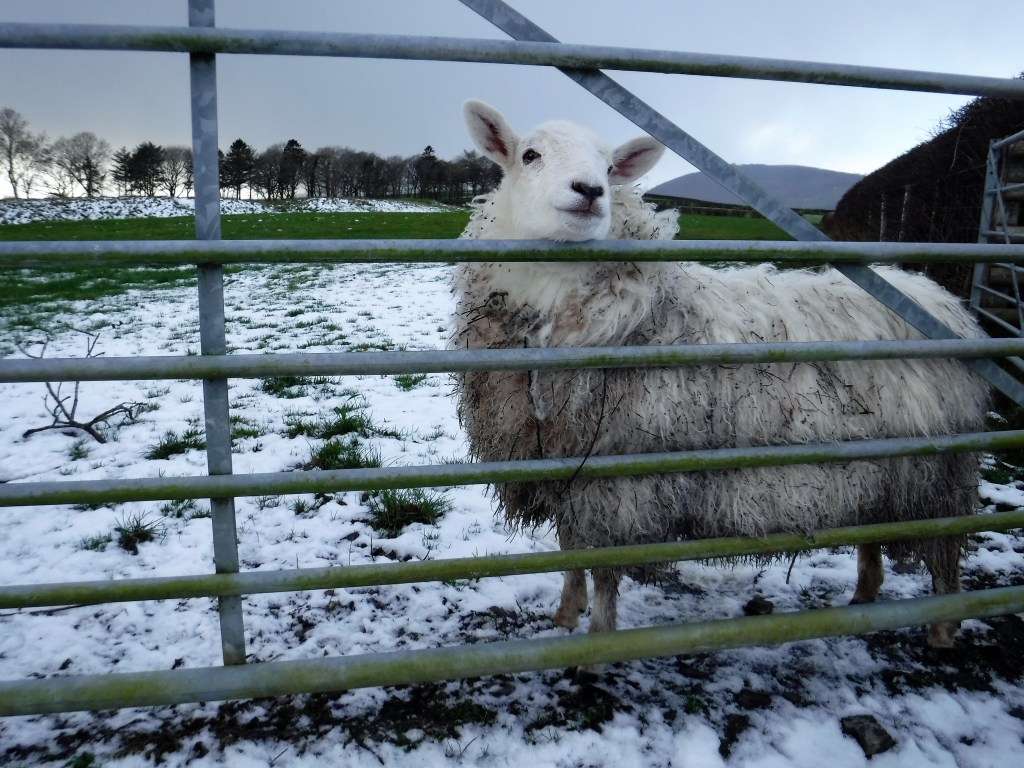
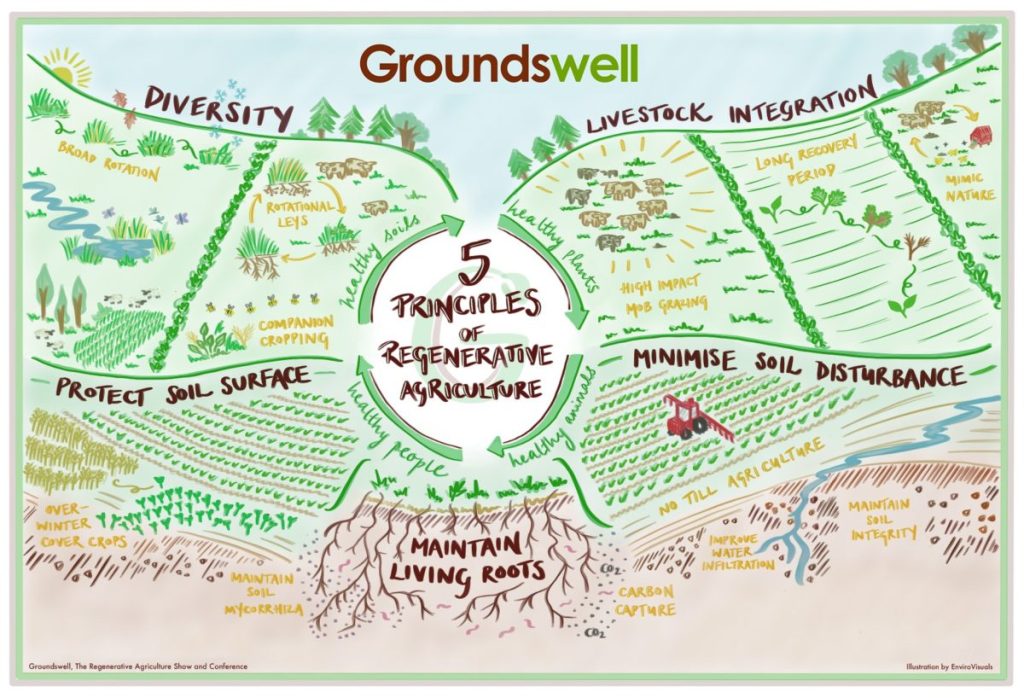
I first met Rona the tame lamb (now sheep*) in the spring of 2020, when Coronavirus restrictions prohibited much contact with humans, and we struck up an acquaintance which has since continued. This reinforced my interest in regenerative sustainability/agriculture and hence the particular resonance of Rebanks’ BBC Radio programme. Wider interest is by no means confined to Britain and I also recently came across a Norwegian initiative called “Amazing Grazing” whose aim is “to bring new knowledge on how sheep rangeland grazing systems can be part of sustainable food and fiber systems.”(13) The project brings together a range of partners from Scandinavia and the United States.(14) David Cutress’ article in Business Wales also highlights North American enthusiasm for RegenAg and draws on research conducted in the Upper Mid West.(10/15) In addition, he asks how this farming model might be better defined in order to avoid potential criticisms of green-washing. The latter is clearly something Groundswell Agriculture are seeking to avoid and their “5 principles” of “soil sense” (Figure 1) are explained in a detailed talk by Karl Ritz, University of Nottingham Emeritus Professor of Soil Ecology.(16)
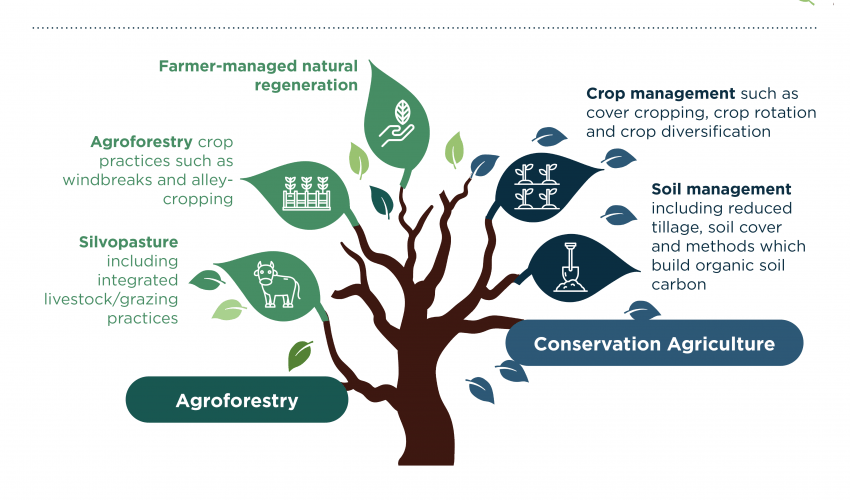
Meanwhile, the IUCN and UNFCCC (United Nations Framework Convention on Climate Change) report on regenerative agriculture in Africa proposes an expanded definition which “encompasses both conservation agriculture and sustainable agroforestry techniques” (see Figure 2 below).(4) The work undertaken with African partners for the COP26 climate conference “provides compelling, quantitative evidence of the positive impacts of regenerative agricultural practices.”
This report presents the case for regenerative agriculture to play a key role within broader land restoration activities and its potential to benefit smallholder farmers, business and society. It demonstrates the benefits of a transition to practices such as agroforestry and soil management as methods to boost yields, improve human nutrition and livelihoods, supporting soil and ecosystem health.
In addition, detailed forecasts up to the year 2040 are provided, by when “through just a 50% adoption of regenerative agriculture across Africa, farmers could see:
- 30% reduction in soil erosion
- Up to a 60% increase in water infiltration rates
- 24% increase in nitrogen content
- 20% increase in carbon content, or higher depending on the intervention – and not just topsoil (this is huge as soil is the second biggest storehouse of carbon, after oceans). The benefits are even greater when shrubs and grasses are promoted through agroforestry” (4)
In this scenario, by 2040, “this additional carbon benefit alone could equate to 4.4 GtCO2e (almost 10 times South Africa’s annual emissions). Another 106 MtCO2e per year could be sequestered by restoring degraded land with the inclusion of agroforestry systems”.
Returning to James Rebanks’ question of “could I regenerate my farm to save the planet?”(1), the short answer is perhaps this: the global groundswell in regenerative agriculture has considerable potential if its principles and practices reflect key spatial differences in the criteria for sustainable land management. Over developed countries may also have something to learn from less developed ones. Those interested in discovering more about RegenAg and related subjects might subscribe to the 2022 Oxford Real Farming Conference or review the Welsh event’s programme from 2021.(17/18)
Note: Rona is a Welsh Mule Sheep https://en.wikipedia.org/wiki/Mule_(sheep)
References
1 BBC Radio 4 – Could I Regenerate My Farm to Save the Planet? https://www.bbc.co.uk/programmes/m0011rxf
2. Groundswell – Regenerative Agriculture Show & Conference Groundswell (groundswellag.com) https://groundswellag.com/
3. https://groundswellag.com/principles-of-regenerative-agriculture/
6. https://www.fwi.co.uk/livestock/beef/orfc-2021-livestock-have-key-role-in-sustainable-farminghttps://inews.co.uk/news/environment/cut-back-chicken-pork-planet-beef-lamb-fine-819441
7. https://ffcc.co.uk/assets/downloads/FFCC_Farming-for-Change_January21-FINAL.pdf https://ffcc.co.uk/assets/downloads/FFCC-Annual-Report-2020-21.pdf
8. https://www.soilassociation.org/take-action/organic-living/why-organic/better-for-animals/
9. https://rewildingglobal.org/wp-content/uploads/2021/11/ANIMATE-THE-CARBON-CYCLE-GRAlliance.pdf
11. https://www.weforum.org/agenda/2019/10/farming-agriculture-biodiversity-wildland/
12. https://www.dailypost.co.uk/news/local-news/rewilding-britain-summit-sea-wales-17119541 https://www.theguardian.com/environment/2021/dec/28/agriculture-recycling-carbon-farmers-reframe-rewilding-debate
13. https://www.oslomet.no/en/research/research-projects/amazing-grazing
15. Accelerating regenerative grazing to tackle farm, environmental, and societal challenges in the upper Midwest (jswconline.org) https://www.jswconline.org/content/jswc/76/1/15A.full.pdf
16. https://groundswellag.com/karl-ritz-the-groundswell-5-principles-and-soil-sense/
 SUISIUM