
Air pollution, decline in biodiversity, climate change are, in my opinion, the greatest challenges of our age. Mike Hedges, MS, Chair’s Foreword, “Environmental Principles and Governance Post-Brexit.” Senedd (National Assembly for Wales) 2019 (1)
Environmental rule of law is central to sustainable development. It integrates environmental needs with the essential elements of the rule of law, and provides the basis for improving environmental governance… Without environmental rule of law and the enforcement of legal rights and obligations, environmental governance may be arbitrary, that is, discretionary, subjective, and unpredictable. United Nations 2013 (2)
The term “environmental rule of law” was mandated by the UN in 2013 with the intention of combating “non-compliance with environmental laws.”(2) A 2019 assessment by the UN Environment Programme found “weak enforcement to be a global trend.”(3) England and Wales are no-exception to this trend and a March 2021 Suisium post highlighted the problems of freshwater pollution in the Severn Basin. Here the focus is on how deregulation, under-resourcing and a pro-development bias in environmental regulation and spatial planning, in particular, are undermining public confidence in systems intended not only to conserve nature and historic landscapes, but support ecosystem restoration.(4) This post covers:
- Importance of hedges in the British landscape (and psyche)
- Legal protection of hedgerows in England and Wales
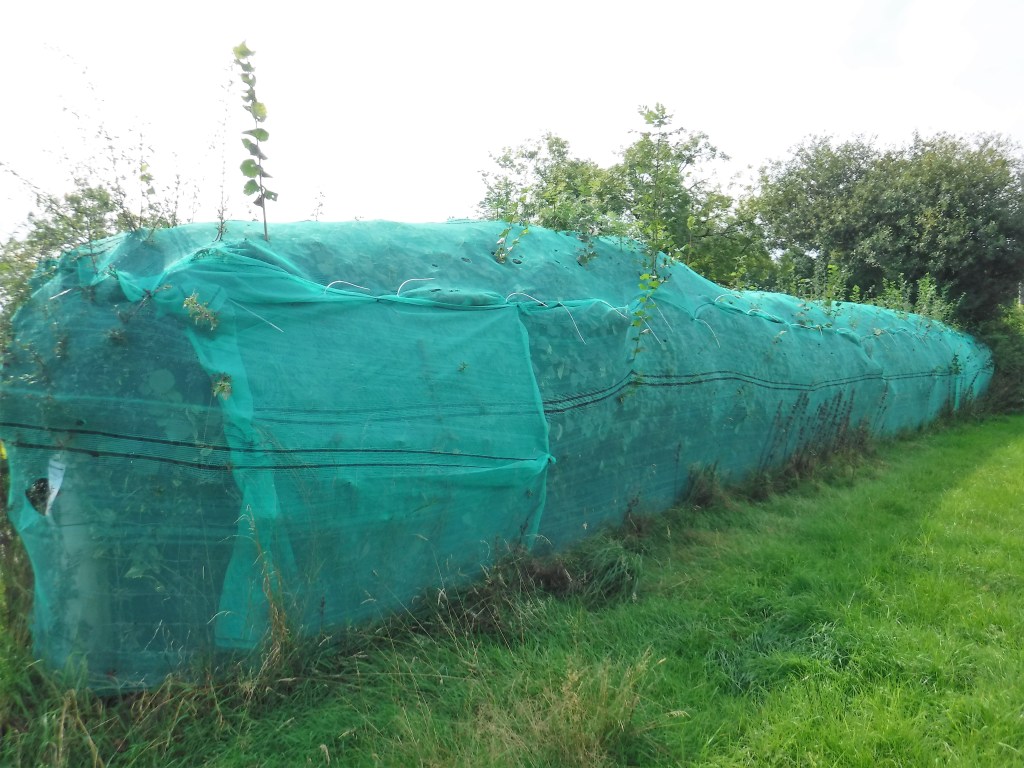
- Recent controversies about developers’ use of hedge nets
- The Rule of Law, environment and spatial planning
Importance of hedges in the British landscape (and psyche)
A September 2021 publication by the Campaign to Protect Rural England (CPRE) highlights the importance of hedgerows in Britain and recommends a 40% increase in the UK network.(5) The report’s Executive Summary maintains:
One of the best ways to simultaneously tackle the climate crisis, boost nature and grow our economy is by restoring and increasing the UK’s hedgerow network. Not only do hedgerows complement and enhance the unique character of our beautiful countryside, they are a haven for nature, remove carbon from the atmosphere and support sustainable local economies. But, shockingly, we have lost 50% of our
hedgerows since the Second World War and they are still in decline.
“Hedgerows have been fundamental to “The Countryside Charity’s” campaigns since the organisation’s inception in 1926, with a famous British architect and planner, Sir Patrick Abercrombie, describing them as ‘part of an elaborate, if unconscious, re-modelling of the earth’s surface, which has taken centuries to mature.”(6) However, by the late 1960s, CPRE “estimated hedgerow loss at 10,000 miles a year (as opposed to the then government’s official estimate of just 500 miles).” (6) Notwithstanding ongoing threats, subsequent campaigns to protect and restore native hedges are a success of modern British nature conservation and have strong support across the broad church of the environmental movement.
Legal protection of hedgerows in England and Wales
Summer 2021 brought the inaugural National Hedgerow Week promoted by The Tree Council in partnership with other partners in Hedgelink. (7) According to its website: “Hedgelink has a particular responsibility for helping to deliver the Habitat Action Plan for hedgerows that forms part of the UK’s Hedgerow Biodiversity Action Plan.” A page on “Hedges, the Law, rules and Regulations” describes the protection granted to hedges in England, although much of this also applies in Wales, in particular the Wildlife and Countryside Act (1981) and the Hedgerow Regulations 1997.(8) The latter “provide important protection by prohibiting the removal of most countryside hedgerows (or parts of them) without first notifying the local planning authority. Removal includes acts which could result in the destruction of a hedgerow.” Nevertheless, whilst “contravention of the Regulations is a criminal offence,” hedgerows defined as “important” – for instance, “at least 30 years old” – continue to be removed, although the rate of destruction appears has decreased in recent years, at least until 2020-21 (see below).
Recent controversies about developers’ use of hedge nets
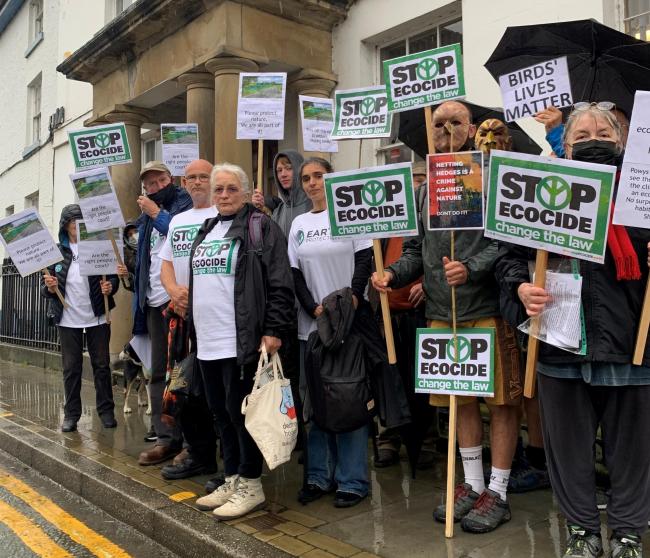
On 22 March 2021, the Powys County Times reported: “Three people have been interviewed by police and “community tension” is being monitored after environmental campaigners removed netting from hedgerows near the site of a planned crematorium in Montgomeryshire.” A spokesperson for the Extinction Rebellion campaigners said of the action: “Hedgerows are the most widespread semi-natural habitat in the UK and we have with the lowest tree cover in Europe, so they are even more vital for UK wildlife.”(9) The incident followed an earlier report on the Nation Cymru website in which the Campaign for the Protection of Rural Wales also criticised the practice of hedgerow netting by developers, especially – as in this case – without planning consent.(10) Welsh Government guidance, incidentally, is clear: “… netting should only be considered as a last resort measure, after a full consideration of other alternatives and under exceptional circumstances only following the grant of planning permission.”(11) Social media responses to the Nation Cymru article suggested that hedgerow removal may have increased in Wales between 2020-21 during extended Coronavirus restrictions.
In April 2019, the Chartered Institute of Ecology and Environmental Management and the Royal Society for the Protection of Birds issued advice “against netting on hedges and trees” (12). This states: “Netting is an overly simplistic approach that has become more prominent recently. There is an understandable negative reaction from both the public and from professional ecologists to the real and potential harm that it may cause to wildlife”. Explicit guidance is also provided on the use of hedge nets where no practical alternatives exist and, most importantly, for development with planning consent. Nets used by the developer – also a county councillor and planning committee member – of the proposed crematorium near Caersws in Powys were used against professional advice and their removal requested by a wide range of people and organisations.(13) The crematorium application was called in by the Welsh Government for consideration by the Planning Inspectorate (Planning and Environment Decisions Wales from 1 October) in August 2021.(14) In the meantime, a criminal damages case is being pursued against four people involved in attempting to remove the, arguably unlawful, hedge nets earlier in the year.(15)
The Rule of Law, environment, and spatial planning
One of the world’s preeminent exponents of the rule of law sought his final resting place in Powys.(16) Buried in St Cynog’s Church, Boughrood, near the River Wye, Lord Justice (Tom) Bingham was described by a former Attorney General as “one of the United Kingdom’s most distinguished jurists in the last hundred years.”(17) According to the UK Government in 2013: “The ‘Golden Thread’ of the rule of law runs through not only the ability to prosecute serious crime and terrorism but increasingly wider agendas such as prosperity, development and growth.”(17) Unfortunately, however, the Birmingham Centre for The Rule of Law has found this “Golden Thread” broken where the environment is concerned.(18) Citing the example of the Environment Bill and the Office for Environmental Protection, a June 2021 article by the centre identifies weak enforcement capacity as having the potential to “undermine the rule of law.” Similarly, a 2016 paper entitled Planning and the Rule of Law concluded that “decision-making in spatial planning is often insufficiently rigorous.”(19) Whilst Wales has a separate planning and environmental protection framework to England, similar weaknesses largely apply. Tom Bingham’s book, The Rule of Law, was published in 2010 and posthumously won the 2011 Orwell Prize for Literature.(20)
Postscript: Public interest in hedgerow netting was reflected in Parliamentary Petition which attracted over 350 000 supporters in 2019. A report on this is available from the House of Commons Library.(21)
References
1 https://senedd.wales/laid%20documents/cr-ld12780/cr-ld12780%20-e.pdf
2. Environmental Rule of Law | UNEP – UN Environment Programme https://www.unep.org/explore-topics/environmental-rights-and-governance/what-we-do/promoting-environmental-rule-law-0
3. https://www.unep.org/resources/assessment/environmental-rule-law-first-global-report
4. https://www.decadeonrestoration.org/
5. https://www.cpre.org.uk/resources/hedge-fund-full-report
6. https://www.cpre.org.uk/discover/hedgerow-highlights-milestones-from-cpres-95-years-of-campaigning/
7. https://hedgelink.org.uk/news/the-first-ever-national-hedgerow-week/
8. https://hedgelink.org.uk/hedgerows/protection
10. https://nation.cymru/news/concerns-raised-over-hedgerow-netting-that-stops-birds-nesting/
12. https://cieem.net/cieem-and-rspb-advise-against-netting-on-hedges-and-trees/
15. https://www.countytimes.co.uk/news/19613895.campaigners-gather-outside-court-quartet-face-trial/
16. https://en.wikipedia.org/wiki/Tom_Bingham,_Baron_Bingham_of_Cornhill
17. https://www.gov.uk/government/speeches/the-rule-of-law-and-the-prosecutor The rule of law and the prosecutor – GOV.UK (www.gov.uk)
20. https://www.orwellfoundation.com/book-title/the-rule-of-law
21. https://commonslibrary.parliament.uk/research-briefings/cbp-8558
 SUISIUM